
'Even if such a thing happens, it will not prolong for many days like Doklam did.' 'That is because both the leaders do not want it.'
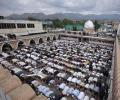
The appointment of General Raheel Sharif as the new army chief of Pakistan has come as a surprise to many. Rajiv Dogra, former ambassador and India's last Consul General to Karachi, speaks to Aabhas Sharma about the appointment, what it says about the priorities of Pakistan Prime Minister Nawaz Sharif and most importantly, what it means for India.
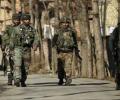
'I am aware that mention of a threat to Gulmarg emanating from my perception may send negative signals to tourists but there are realities which need to be taken stock of.' 'Gulmarg is not far from Srinagar and is what the army calls in its parlance "a big name place." Such places draw attention much faster when negative incidents take place and give value of eyeball attraction.'

'Kargil was Pakistan's strategic blunder. India must remain on guard against such sinister operations being launched in future by Pakistan's vengeful and devious military leadership that continues to have a hate-India mindset and the mentality of primitive warlords,' says Brigadier Gurmeet Kanwal (retd).
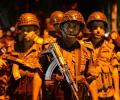
All the hostages killed during the 12-hour siege by Islamic State terrorists were foreigners, with most being Italian or Japanese.

'The Senators were playing safe, not angering either the pro-India lobby or the pro-Pakistan lobby, but perhaps more importantly, the military-industrial complex -- the most powerful lobby of all -- which the majority of Senators are beholden to in terms of largesse to their campaign coffers.'

Begin with ITC. Larsen & Toubro, yes. ICICI and HDFC, yes again.
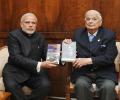
Tarun Vijay, MP, salutes the General whom he adored as a great friend.

Cyberspace is a battleground as important as the traditional domains of air, land, sea and space, says US Defence Secretary Ash Carter, who visits India next week.
The two countries that will be most affected by the internal developments in Pakistan are India and the United States, says Bob Blackwill. Aziz Haniffa reports

Is North Korea really dismantling its nuclear programme? Rajaram Panda explains the many challenges to denuclearise the Korean Peninsula.

The two countries also asked all nations to stop cross-border movement of terrorists and asserted that a decisive collective response from the international community without 'double standards and selectivity' was required to combat the threat of terrorism.

'Over the last two decades, the India-French relationship has grown steadily, no major political difference having darkened the sky between Paris and Delhi,' says Claude Arpi.
Despite major setbacks, the Maoists' ability to inflict damage on the State and maintain its position as the saviour of the tribals will keep them relevant, says Bibhu Prasad Routray.
'More needs to be done in less time,' says Vivek Gumaste. 'A sense of urgency is crucial if the BJP wishes to fulfil its promise of tough, no-nonsense, governance in matters of security.'

Dr Swarnim Wagle, the official behind Nepal's reconstruction strategy, speaks to Patrick Ward.

'China any day would prefer to team up with India and dump Pakistan once the resolution of the border dispute becomes an accomplished fact.'

'Pakistan thinks it is winning this low intensity conflict.' 'It is a serious observation. Half the battle is convincing your adversary that he cannot make headway.' 'A lot depends on how the internal professional management of the army and the handling of situations that are bound to rise sooner than later in his command, are done.'

The perfunctory management of external affairs has left India's foreign policy establishment largely unprepared to manage the consequences of dramatic international developments, says Nitin Pai.
'If his three priorities are the economy, the economy, the economy, then there is need for a stable region, a stable neighbourhood.'

It is time to throw an outer ring around India's national security by proactively engaging in areas immediately outside our neighbourhood. Such a ring will not only insulate India from emerging threats, but also create new leverage in securing our own neighbourhood, says Nitin Pai.

'Voting also involves communal factors, caste factors and so on, but increasingly, the caste factor is making less and less sense to the Indian voter,' says journalist and author Manu Joseph.

Instead of a consumption stimulus the government must address the NPA issue with a war footing and invest in infrastructure, affordable housing and exports, says Sanjeev Nayyar.

'The ISI doesn't trust the Kashmiris. They hate them...' 'We can never take Kashmir for granted, so there is that element of unpredictability. Anything can happen anytime.' 'The next chief minister will still be from the Valley. Even if a BJP chief minister or a BJP chosen candidate comes, he will be from the Valley. And he will be a Muslim.' A S Dulat, the former R&AW chief, on why he is perplexed by the BJP's Mission 44 plan for the J&K assembly election.

'It is a national shame that the only country that enacted a food security act is now better known as the land of farmer suicides. Indian farming can change only if national irrigation policy is implemented in totality,' Dr M S Swaminathan tells Shobha Warrier/Rediff.com

Protesting against enforced disappearances in Balochistan, Abdul Qadeer Baloch, 72, has led a small group that has covered more than 2,000 kilometres on foot, breaking the 84-year-old record set by Mahatma Gandhi during his Dandi march. Hamid Mir reports from Islamabad.
.jpg)
The Indian Army must be given a free hand to retaliate punitively at one or more places of its choosing on the LoC. The aim should be to cause maximum damage to the forward posts of the Pakistan army, particularly those through which recent attacks have been launched, thereby raising the cost for the army, says Gurmeet Kanwal.
'If India employed a strategy of a 'thousand cuts', Pakistan will wither away.'

'Obama's decision to end the US military involvement in the Afghan civil war needs to be welcomed as a positive development for regional security and stability. India, too, has a great opportunity opening up here if it plays its cards in sync with the spirit of the times rather than continuing to view the Afghan problem in zero-sum terms,' says Ambassador M K Bhadrakumar.

Minister for External Affairs Salman Khurshid speaks about the importance of the fourth edition of the India-US Strategic Dialogue, which he co-chaired with United States Secretary of State John Kerry in New Delhi

'This is what we train for: That one chance to deliver a blow so lethal that the enemy will constantly think about it when planning any misadventure.'

'If Indian armed forces entered Pakistan and succeeded in inflicting major damage on the Pakistani army and occupied territory in the Pakistani heartland, there is reason to think the Pakistani military would use some nuclear weapons against the incoming Indian forces to compel India to stop.'

To redevelop cities as 'smart', investment of at least $10 billion is required. For 100 cities, it works out to $1 trillion

If Indian PM boycotts the CHOGM, it is likely to add to Sri Lanka's bitterness. This would not help India's desire to add more depth and content to its relations with Sri Lanka but its ability to influence Sri Lanka's decision making process on the both strategic issues and on Tamil minority issues, says Colonel (retd) R Hariharan.

While filled with startling insights and questions, and buoyed by terrific performances throughout, Newton suffers from a lack of end-to-end clarity. It is a near-great film but one that for some reason doesn't express itself fully, feels Sreehari Nair.

'The ISI has given a stunning display of its capacity to do with impunity what it likes within Kabul. Incensed over the triumphalism of the hardliners in Kabul, the ISI has hit out; it is a typical ISI reflex action that Indians are familiar with,' says Ambassador M K Bhadrakumar.

One hopes the higher courts take the extraordinary steps needed to secure justice for the victims. The Gujarat carnage demands nothing less because of its unique nature and sponsorship by the State, argues Praful Bidwai.

The India card is now almost obsolete. There are more pressing challenges. People of Pakistan are fed up with years of bad governance, corruption and broken promises of successive governments. However, the politicians and former generals are still provoking sentiments on what is happening on the Line of Control for petty political gains, says Shahzad Raza.

The Forbes 30 Under 30 list is harder to get into than Stanford or Harvard University. Meet the desis who made the cut this year.

'We cannot forget that Pakistan is a criminal State, it is a rogue State and yet we want oil pipelines to go through their State, we want to have people-to-people contact, want to increase trade with them.' 'When Modi was prime minister-elect, he said there can be no dialogue in the face of bombs and bullets. After becoming prime minister, he is saying talks will continue. Was he then misleading the public then or is he misleading the public now?' 'Nobody goes around abusing China. The fact is China is a great power. I do not think India is a great power. People spit on our face and we still go grovelling before them.'
